

What does Epic Clone do?
With Epic Clone, you gain the enhanced capability to clone an epic along with all its associated issues in a single action. In contrast, the standard cloning feature in Jira allows you to clone only the epic issue itself, with the option to include attachments, links, or sub-tasks. However, issues connected to the epic via the epic link field cannot be cloned simultaneously with the epic during the same cloning process.
Epic Clone also offers the flexibility to configure cloned epics and their associated issues. This functionality extends to cloning across different projects as well. The following issue attributes can be modified:
Epic:
-
Target project (also all issues in epic will be cloned to that project)
-
Summary
-
Assignee
-
Epic name
-
Find and replace for description
-
Component(s)
-
Fix version(s)
-
Security level
-
Original estimate
-
Due date
-
Labels (add custom label)
Issues in Epic:
-
Add summary prefix
-
Add summary suffix
-
Find and replace in issues summaries and / or descriptions
-
Original estimate
-
Due date
-
Assignee
-
Labels (add custom label)
-
Story points (for stories only)
When it comes to attachments, sub-tasks, and linked issues, you can choose whether to clone them or not.
How can Epic Clone be used?
Upon installing the app, you will notice an additional option in the "More" menu of Epics, labeled "Clone Epic Template."
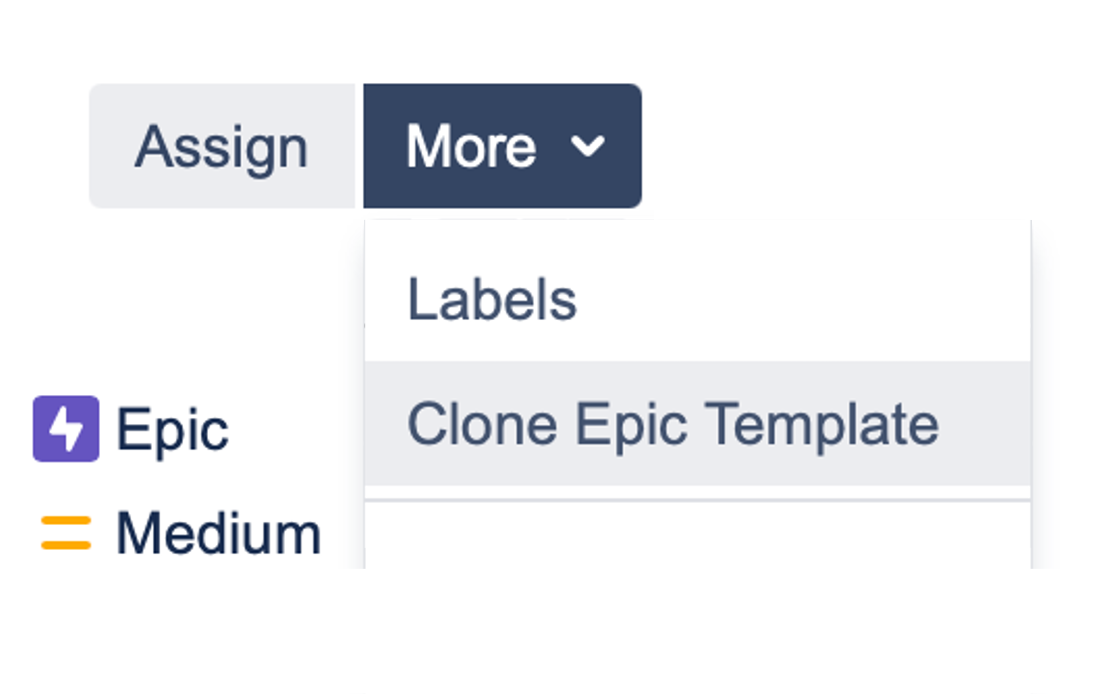
Clicking on that entry will open the epic clone configuration.
You can find detailed information about the Epic Clone process here: Clone Process
What can Epic Clone be used for?
The app could be particularly valuable for you, especially if you have template epics that you wish to reuse. Its cross-project cloning functionality enables you to establish template epics within a designated template project and seamlessly transfer them to active projects whenever needed.
Consider a scenario where you work in a software development company and require certain modules for every software application you create. Often, the stories associated with these modules will be similar across different projects. By having them organized within a template epic, you can significantly reduce the effort involved in creating and structuring these issues. This allows you to clone the entire epic, along with all its issues, in one swift action whenever necessary.
At the start of each project, you can rapidly establish the structure with epics and issues. With the epic cloning feature, you can easily replicate the template epics and their associated issues into your new project, assign them to the appropriate team members, and set estimation values—all in a single action for each epic. This streamlined process saves you considerable time compared to manually setting up a new project, allowing you to concentrate on the truly important tasks at hand!
Can the access to Epic Clone be restricted?
Jira administrators have the ability to restrict access to the epic cloning feature for specific user groups or projects. This functionality can be particularly beneficial when dealing with extensive epics that should only be duplicated by users who are knowledgeable about the process. For instance, in such cases, cloning could be limited exclusively to administrators.
Another scenario might involve allowing cloning solely from designated template projects while preventing it from productive projects in general. In this way, the epic cloning capability can be confined to those specific template projects.
For more details, please have a look at this page: Epic Clone Administration
If you experience a bug in the app, if you have an idea for improvement or if you have another topic you want to talk about, feel free to visit our service management or contact us via support@ij-solutions.atlassian.net